Every figure from its filing.
Tark reads the filings behind alternatives and benchmarks them across all six factors, helping managers weigh each option through an independent and predetermined process.
Registered, private and plan-level, current and past
Each tied to the filing it came from
The rest are marked as read from prose
Schedule H filers, plan year —
No advice, no verdicts
What the committee actually files.
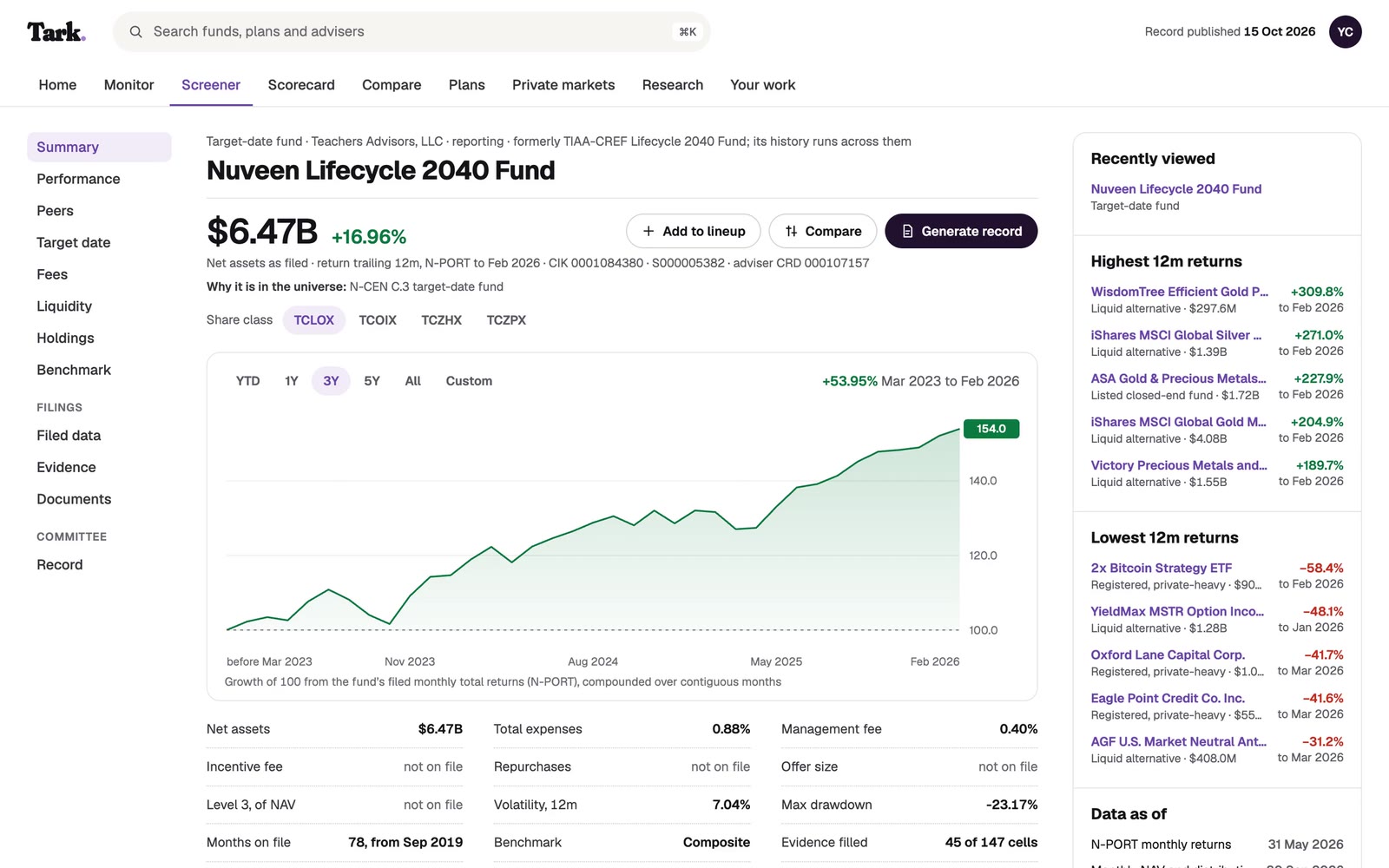
One document per option on the lineup: six factors, which includes a final benchmark decision and liquidity tests.
- 1
Summary on page one
Evidence filled, the benchmark result and the liquidity result, before any detail.
- 2
Six factors, cell by cell
Up to — defined cells a fund. Each shows its value, the filing and the section, and whether it came from tagged data or from prose.
- 3
The benchmark, and the ones passed over
Every candidate index scored against the rubric, with the reason each one lost.
- 4
Liquidity against this plan
Repurchase capacity measured against the plan’s own Form 5500 outflows, with a stress case.
- 5
Quotes and sources at the back
Values read from prose carry their supporting quote. Every source document is listed.
As HTML and Markdown with its appendices. The plan can be named for your own files, or anonymized to a reference label with its sponsor, EIN and filing identifier withheld.
Five separate tasks a fiduciary no longer needs to do analog.
Six factors, up to — cells a fund.
Performance, fees, liquidity, valuation, benchmarks and complexity. Each cell is linked to its source, flagged as read from prose, or left blank.
A benchmark you can defend.
Every candidate is scored against the same rubric. Only an index that clears the bar fills the slot, and an index from the fund’s own adviser never does.
Robust Liquidity Testing
The fund’s repurchase capacity is compared with the plan’s own outflows from Form 5500, pro-rata and under stress.
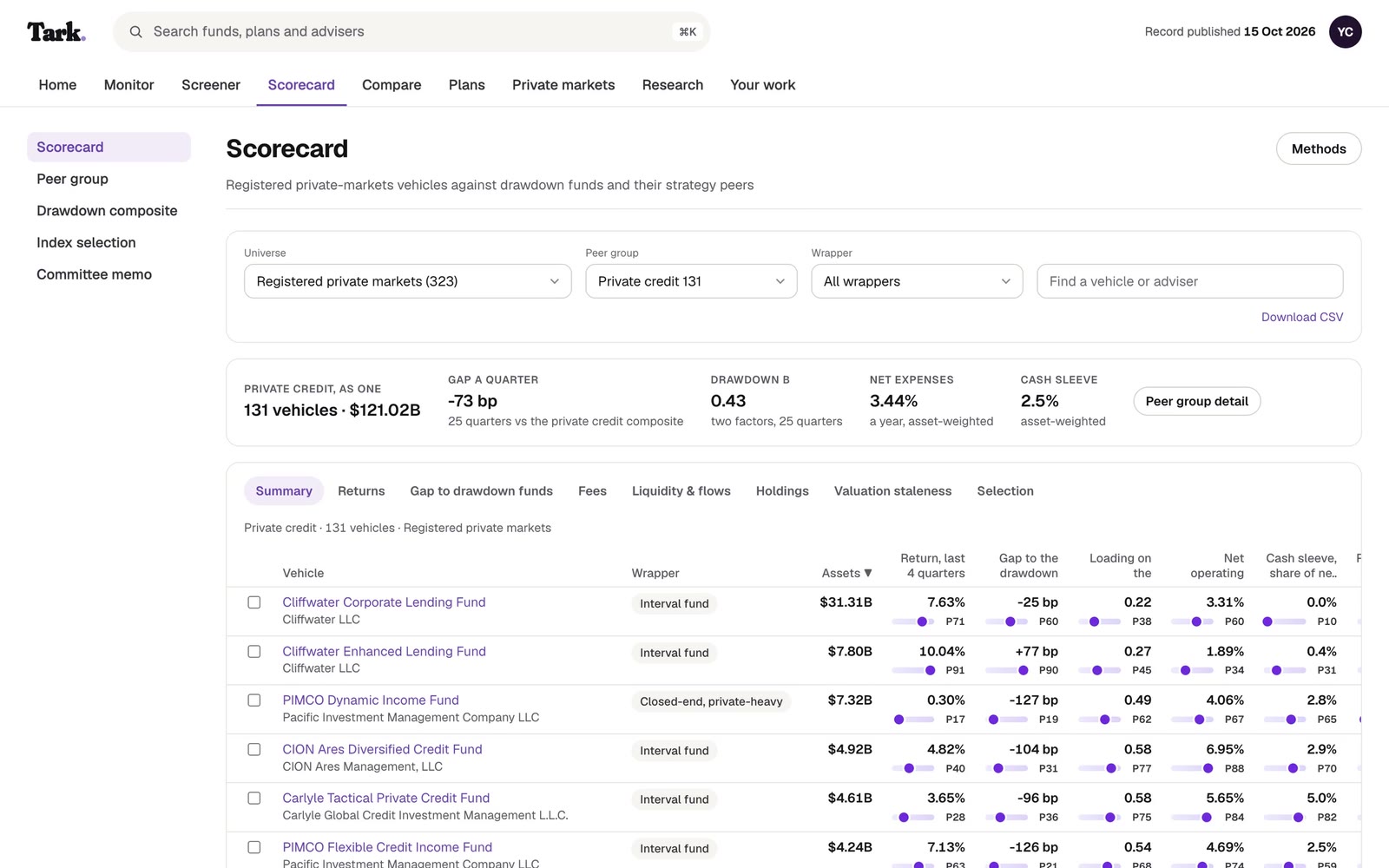
Ranked against real peers.
Ranking includes the most important factors needed to make a prudent decision: the gap to drawdown funds, fees, cash, redemptions and months with no change in value.
The record, always available
Our read-only API returns the same figures and sources the app shows.
One benchmark chosen, to help you make the prudent decision
Each fund is scored against up to — candidates: — published indices, the fund’s own stated benchmark where it states one, a peer cohort built from filings, and public market equivalent math.
- 01
Clearing the bar fills the slot
An index fills the slot only if it clears the rubric. One published by the fund’s own adviser never does.
- 02
Ties break on independence
The tied index is recorded as an equally defensible choice the committee may prefer.
- 03
Peers beside, never instead
A peer cohort built from filings sits next to the benchmark. It is never presented as the benchmark.
- 04
Descriptor only, never a stand-in
If an index series is not licensed, the record names the index and shows no number. Nothing is substituted.
- 05
The engine can refuse
When no candidate clears the bar, the record says so instead of forcing a pick.
Built from primary filings and only published when we’re confident an asset can be benchmarked
Every value names the filing it came from. Each run rebuilds the record from its sources and tests it. A run that fails publishes nothing.
- 01
Collect
The pipeline picks up what is new from every publisher: SEC EDGAR, Form ADV and Form D, the DOL’s Form 5500 file, sponsor sites and public LP reports.
- 02
Read
Figures come from tagged filing data where it exists. A value read from prose is marked unverified and keeps its supporting quote.
- 03
Read again
Rows parsed from a PDF are read a second time from the page image, and the Sources page shows how many have been. A disagreement becomes a flag beside the row, never a figure.
- 04
Label
Each value is verified, unverified, inferred or absent. A gap stays a gap. Nothing is estimated in its place.
- 05
Test
Every derived table is rebuilt and tested. A failed test stops the run, and the site keeps the last published snapshot.
- 06
Keep
Source files are held as served. A copy taken from the Internet Archive must match the archive’s own SHA-1 digest, byte for byte.
Registered funds
—Interval, tender-offer, BDC, non-traded REIT, listed closed-end, liquid alternative and target-date funds
N-PORT · N-CEN · N-CSR · 10-KPlan trusts
—Collective trusts, target-date trusts, pooled separate accounts and 103-12 entities
Form 5500 · Schedules D and HPrivate funds
—Private funds on Form ADV, Reg D funds and private REITs on Form D
Form ADV · Form DCounts include vehicles no longer reporting. They stay on the record with the date of their last filing.
One record. Three readers.
The committee decides. The adviser prepares the file. Counsel checks it. All three read the same record, providing total coverage.
Plan committees
Weighing an alternative for the lineup and needing the process on paper.
- One record per option, ready for the minutes
- All six factors, every figure cited to its filing
- Liquidity tested against the plan’s own Form 5500 outflows
Advisers and consultants
Screening, benchmarking and documenting across many plans at once.
- Screen — vehicles by wrapper and strategy
- Peer groups and percentiles computed from filings
- Review a client book: upload a CSV and match each holding to its filer
ERISA counsel
Checking that the process is documented and can be defended.
- Every value traced to a filing and a section
- Values read from prose keep their supporting quote
- Records export as HTML and Markdown, named or anonymized
Put your own lineup on the record.
Bring the alternatives you are weighing, and we will build their records with you. Let us help you compare apples to apples, and oranges to oranges.